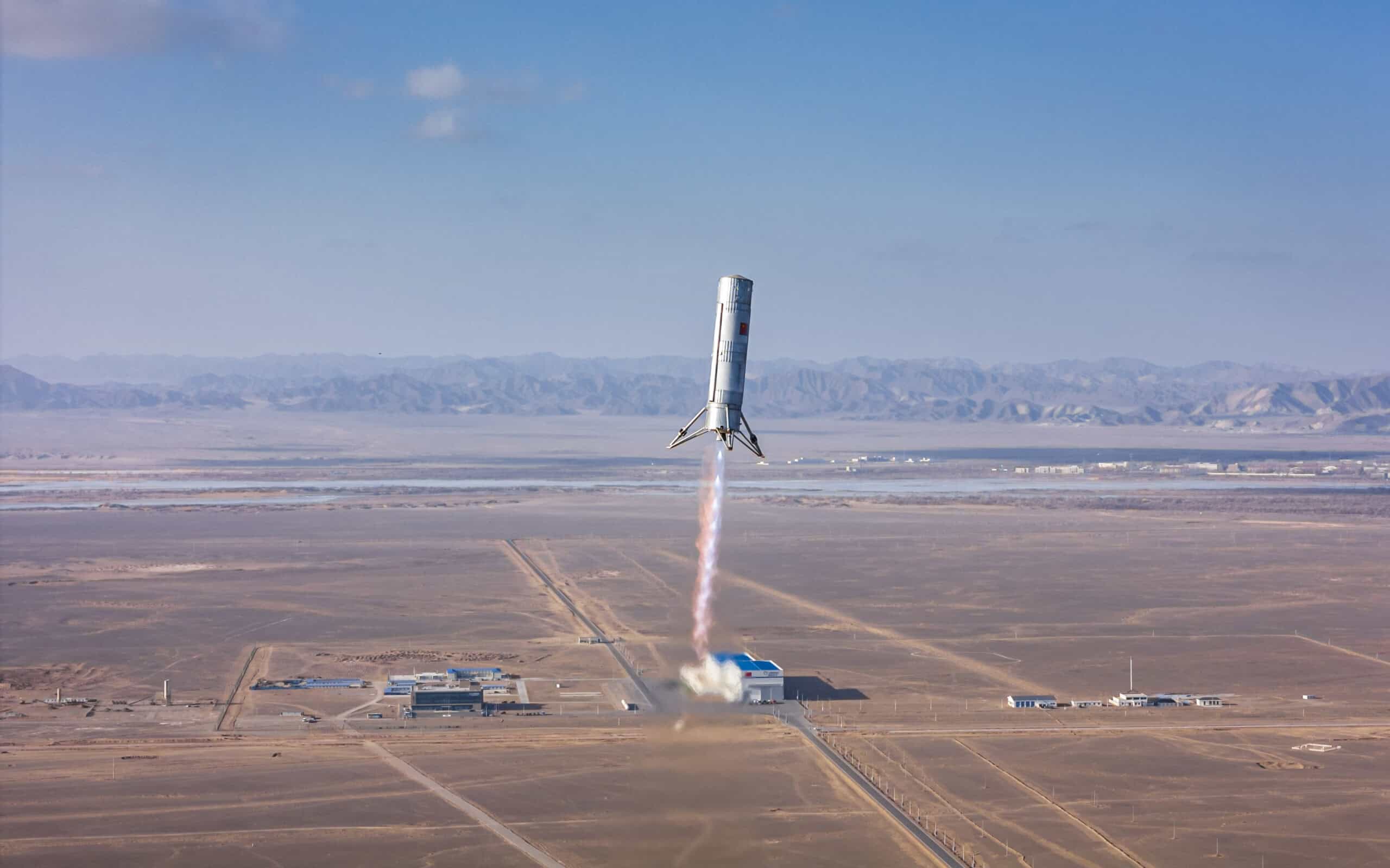
China’s efforts to become a leading global power in commercializing space took another step forward earlier this month, when Beijing-based Landspace became the first Chinese company to attempt to launch and re-land a reusable rocket. Its Zhuque-3 rocket reached orbit after taking off on December 3, but its reusable “first stage” component, which ignites during the first phase of a rocket’s launch, missed its landing and crashed just next to the launch pad.

Undeterred, LandSpace still counts the mission as a success: the company said in a statement that. Zhuque-3’s flight had “obtained key engineering data under actual flight conditions.”
Perfecting reusable rockets remains an enticing goal with enormous potential rewards for the firm that can master it first, experts say. The ability to repeatedly send the same rocket launch vehicle into space, laden with cargo such as satellites, could transform the industry’s economics, as well as broaden access to space beyond governments or industry elites.
“Rockets have, really, one purpose. It is to put things into space,” says Mason Peck, an aerospace engineering professor at Cornell University and a former NASA chief technologist. “You want to put things into space for as little money as you can and as reliably as you can. So it’s not reusability itself that is the goal, [so much as] it’s lowering the cost by virtue of reusability.”
THE PATH TO PROFIT
China and the United States have each seen a record number of rocket launches this year, but growth in each country has come from different sectors.

In China, state-led institutions dominate: 67 of the total Chinese rocket launches in 2025 were so-called ‘expendable’ Long March rockets, manufactured and launched by the state-owned China Aerospace Science and Technology Corporation (CASC) and other state-owned manufacturers.

Private companies have launched rockets in China over the last decade, but the total number remains under 50.
The private sector dominates rocket launches in the United States, although that’s mainly down to one company: Elon Musk’s SpaceX. Its reusable Falcon 9 alone has completed 165 launches this year.
China’s private rocket companies are developing reusable rocket technology as their best path to profitability. Just as no one would throw away a car once it has run out of gas, it doesn’t make financial sense to design a rocket for single use, says Peck.
No single leader has emerged among Chinese private launch firms, though standout companies have achieved notable firsts:

USEFUL REUSABLES
Developing a reusable rocket industry is key to China’s space ambitions, as it will make it easier to transport and build satellite constellations akin to Elon Musk’s Starlink. In the future, it could also make it cheaper to establish orbital data centers and other infrastructure, says Blaine Curcio, founder of Orbital Gateway Consulting, a Chinese space industry data provider.
“If China wants to have their own version of Starlink, which they certainly do, they need to have, among a whole bunch of other things, reusable launch vehicles,” says Curcio. “If commercial launch companies can put onto the launch pad a rocket that can plausibly launch 18 to 36 few-hundred-kilograms-each satellites for these Starlink-like constellations, they’re going to have a business for quite a long time.”

China’s highly ambitious satellite deployment plans dwarf what the private launch industry is currently capable of delivering. Take the Qianfan, or Thousand Sails, constellation, operated primarily by government-owned Shanghai Spacecom Satellite Technology, which currently has 108 total satellites but aims to reach about 1,300 by 2026 and 15,000 after 2030.
China will need to achieve such numbers if it’s going to match the satellite constellations of Starlink, which alone added more than 2,300 satellites just between mid-2024 and July 2025 — carried to space by more than 100 SpaceX launches.
Without reusable rockets, it will be difficult for China to match that number of launches. “When you get to launching a certain amount of stuff, it’s almost impossible from a supply chain and cost perspective to build that many rockets,” says Curcio. “The cost of building so many rockets without re-use makes the business case for launching so regularly completely untenable.”

Reusable rocketry would bring down prices across the industry, not only for the firms building the rockets. Sending a satellite into space on SpaceX’s reusable Falcon 9 used to cost $10,000 per kilogram. Now, it’s as low as $2,500. Satellite companies would also be able to save money as the cost of shipping their product to space drops.
“Lowering the cost of space access democratizes space and accelerates economic activity,” says Peck. “Individual companies, countries, maybe even universities, and others that weren’t able to do so before can now learn from and take advantage of space.”

Savannah Billman is a Staff Writer for The Wire China based in NYC. She previously worked at the National Committee on U.S.-China Relations.